
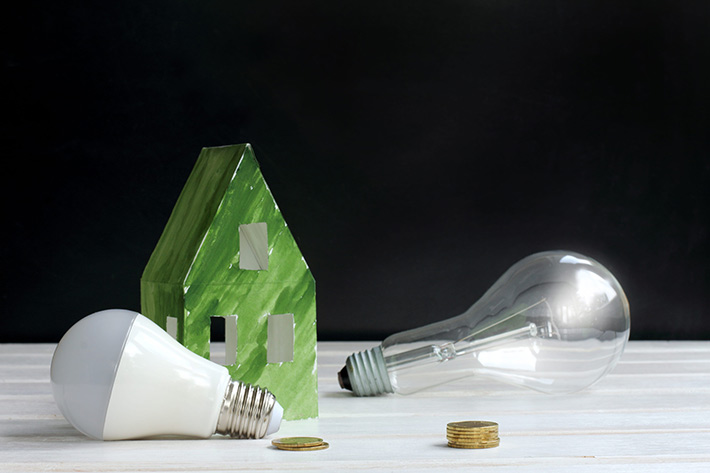
Walk down the lighting aisle at any hardware store, and you’ll see it right away: incandescent bulbs, the default for most of the 20th century, now sit next to a competitor that’s basically taken over: LEDs.
Whether you’re renovating a room, swapping out a bulb that just burned out, or trying to shave a few dollars off your electric bill, it helps to understand what separates these two technologies before you buy a case of the wrong one.
What’s the Difference Between LED and Incandescent Bulbs?
LEDs use up to 85% less energy than incandescent bulbs and can last 15,000 to 25,000 hours, compared to roughly 1,000 hours for a standard incandescent.
The gap comes down to how each one makes light. An LED conducts current through a semiconductor and produces little heat as a byproduct. An incandescent, on the other hand, heats a metal filament until it glows, which is a wildly inefficient process, since most of that energy ends up as heat instead of light.
That one difference in mechanism is really the root of everything else: cost, how long the bulb lasts, how hot it gets, even the color of the light it puts out.
Picking a bulb isn’t purely a math problem about kilowatt-hours. It’s also about matching the light to the room. Below we’ll get into the actual pros and cons of each type, then talk through where LEDs make sense and where an incandescent might still be the better call.
LED Bulbs: Pros and Cons
LEDs win on efficiency, and it’s not close. They convert most of their energy into usable light instead of wasted heat, which shows up directly on your power bill. A single LED can run for over a decade under normal use, so you’re not constantly climbing a ladder to replace one. They also hold up better to vibration and frequent switching, which is good news for fixtures near doors or in garages.
Because they run cool, they’re safer in enclosed fixtures or near curtains and paper. And they come in a huge range of color temperatures now, from warm amber to crisp daylight, with plenty of dimmable options.
That said, they’re not perfect. LEDs still cost more upfront than incandescents, though the price gap has shrunk a lot in the last few years. Older dimmer switches sometimes weren’t designed for LED loads, which can cause flickering unless the dimmer is upgraded as well. And cheaper, bargain-bin LEDs can cast a harsh or artificial-looking light compared to a good incandescent bulb.
Incandescent Bulbs: Pros and Cons
There’s a reason people are still nostalgic for these: incandescents give off a warm, soft glow that many people prefer, especially in spaces meant to feel cozy. They’re cheap to buy, they work with literally any dimmer without complaint, and they hit full brightness the second you flip the switch.
The downside is efficiency, or the lack of it. About 90% of the energy an incandescent bulb uses gets lost as heat rather than turned into light. They burn out faster than LEDs, so you’re replacing them more often. That heat output can also be a real safety issue near flammable materials, and it works against you in summer when your AC has to compensate.
On top of that, many regions have already restricted or phased out the sale of standard incandescent bulbs, so availability isn’t what it used to be.
Which Bulbs Work Best in Which Rooms?
LEDs tend to make the most sense in:
● Kitchens – where you want bright, even light for prep and cooking, and where the switch gets flipped constantly.
● Home offices – where a cooler, daylight-toned LED reduces eye strain during long stretches at a desk.
● Bathrooms – since LEDs handle frequent use near mirrors without generating extra heat.
● Outdoor fixtures and security lighting – almost a no-brainer for LEDs, given how long they last in hard-to-reach spots.
● Closets and hallways – where lights are constantly switched on and off.
Incandescents still hold their own in:
● Living rooms and bedrooms – where that warm glow (especially paired with a dimmer) creates a more relaxed atmosphere than most cool-toned lighting can.
● Dining rooms – where people often lean toward incandescent lighting, particularly with chandeliers or decorative fixtures, where the warmth of the light matters more than efficiency.
Worth mentioning: a lot of warm-white LEDs now do a genuinely convincing job of mimicking that classic incandescent glow, so you don’t necessarily have to choose between ambiance and efficiency anymore.
Related Electrical Questions
Do LED bulbs really save money in the long run?
Yes, even with a higher sticker price, the lower electricity draw and much longer lifespan usually mean LEDs cost less overall by the time you factor in replacements and energy use.
Are incandescent bulbs being banned?
Several countries and U.S. states have phased out the manufacturing and sale of standard incandescent bulbs, though some specialty and decorative versions are still available.
Can I use LED bulbs in any fixture?
Mostly, yes, but enclosed fixtures, dimmer circuits, and three-way lamps sometimes need LEDs specifically rated for that use, check the packaging before assuming compatibility.
What is color temperature, and why does it matter?
It’s measured in Kelvin and describes how warm or cool a light looks. Lower numbers, around 2700K, give you that familiar warm-yellow incandescent look. Higher numbers, 5000K and up, shift toward a cooler, bluer light better suited to task-heavy spaces like kitchens or offices.
Making the Switch: Which Bulb Wins For You?
Incandescents haven’t completely disappeared, and honestly, they still make sense in rooms where warmth and dimmer compatibility matter more than efficiency. But for most of the house, LEDs have become the obvious choice because they cost less to run, last years longer, and now come in tones warm enough to replace incandescents almost anywhere.
The best approach is usually a mix: efficient LEDs in the kitchen, office, and high-traffic spots, and warmer lighting where you actually want to unwind.
Upgrade Your Lighting with Bratcher Electric
Choosing between LED and incandescent bulbs is only one part of creating a safe, efficient, and comfortable lighting system. Bratcher Electric in Wayne can help you plan, upgrade, and install lighting throughout your home or business.
Our full-service electrical firm handles lighting installations, electrical upgrades, new home wiring, code updates, surge protection, service maintenance, backup power systems, and more. Proudly serving Michigan homes and businesses since 1956, we have the experience to keep your electrical system safe, reliable, and up to date.
Contact our electrical contracting firm today for a free consultation.