
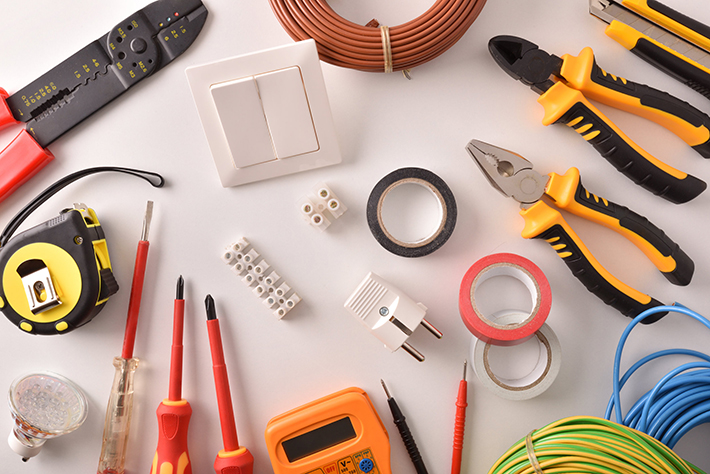
Electricity is the backbone of society. Without electricity, technological advancement would be nearly impossible, and the world would still be in the dark ages. This is why electricians are indispensable. Electricians undergo extensive training in the tools and processes of their trade in order to repair, maintain, and advance the field of electricity. One component that allows them to do this are the various tools handheld tools.
So, what are some essential tools that every electrician should typically carry with them?
The most common tools that electricians should have on hand are pliers, wire cutters, and screwdrivers. Tools to test electrical voltage, cut conduit, and fish tape are also extremely important.
We will discuss these electrical tools and their purposes in more detail below.
Pliers and Wire Strippers
There are many different types of pliers that electricians use regularly, each with their own capabilities and benefits. Below is a list of some of the different types of pliers that electricians work with.
Channel Lock Pliers – Also known as groove joint pliers, these are the typical tool used for gripping nuts and bolts and holding irregularly shaped objects. These pliers have grooves or teeth that are perfect for gripping.
Lineman’s Pliers – Lineman’s pliers are used for manipulating the form of wire. They cut, straighten, twist, pull, and conduct many other wire movements in order to have the wire fit electricians’ needs.
Diagonal Pliers – While lineman’s pliers do have the capability of cutting write, they may not fit into tight areas such as panels or outlet boxes. This is where diagonal pliers come in. Diagonal pliers have a shorter end and are able to reach into narrow and crowded spaces. They also have an angle to them that allows them to lie flush with a surface for easier cutting. Due to the shorter blade, though, they are not an ideal choice for snipping larger wires.
Long Nose Pliers – These pliers are perfect for manipulating wire movement by grabbing, pulling, pinching, and more. Long nose pliers are universal and may be one of the most used pliers in electricians’ toolbelts.
Wire Strippers – Wire strippers are not pliers, but they are similar in look and shape. The purpose of wire strippers is to remove insulation from wires. Wire insulation holds wires together and acts as a containment mechanism for electrical currents. Electricians must remove this insulation in order to work on and replace wiring.
Screwdrivers
Almost every tradesman or woman requires a set of screwdrivers. Screwdrivers are an extremely practical and useful tool, and it is important to get multiple sizes as you never know which size will come in handy. For electricians specifically, insulated screwdrivers are an important addition to their toolbelt. The metal portion of these screwdrivers are covered with a non-conductive plastic that mitigates electrical arcs and sparks to protect electrician safety as well as delicate electrical components.
Voltage Meters and Testers
The purpose of voltage meters and testers is to help electricians understand where there is electrical current and what the current is doing. A voltage tester is a handheld device that will emit a glowing light or a sound when it is in the proximity of a live wire. If there is no light or sound, then there is no electrical current. This tool is important for electricians to identify wire that is safe to work on and what wire may require some extra precautions.
While a voltage tester tells electricians if there is an electrical current, clamping voltage meters tell them what the electrical current is doing. This is a handheld tool that is excellent for testing and troubleshooting as it measures voltage, frequency, and continuity. It is an easy-to-use tool that electricians rely on regularly.
Conduit Cutting Tools
Electrical wires are sometimes located withing metal piping, and when electricians need to access these, they must first cut through the metal piping. Electricians use saws and blades to cut conduit and access these wires, but when the location of the conduit is too narrow for a saw, electricians rely on conduit cutters. Conduit cutters use a cutting wheel to score around the diameter of the pipe until it is brittle enough that the pipe can snap apart. After the conduit is successfully cut, electricians use a tool called a pipe reamer to debur the pipe. This removes any sharp edges on the cut pipe so as to not damage any wires.
Fish Tape
Fish tape, also known as snake wire, is a long, stiff wire-shaped tool whose purpose is to pull wires through enclosed areas such as conduits, walls, ceilings, and anything else. Wires can be extremely long, and it can be difficult to get them to go exactly where you want them to, so fish tape aids in this endeavor. Two material options for fish tape are steel and fiberglass. While both have their uses, fiberglass has the added benefit of being non-conductive, so it does not have the ability to emit sparks or cause electrical arcs.
Electrical Expertise
There are numerous tools that electricians use on a daily basis and mentioned above are just a few of the essential ones. These tools give electricians the ability to repair and maintain electrical equipment that everyone in society use on a daily basis. Electricians are indispensable to the continuation of today’s everyday life, and these tools are indispensable to electricians.
Electrical Services for Home and Business
If you are in need of electrical services for your home or business, look no further. Bratcher Electric has been a # 1 Choice in Wayne Michigan and beyond for over 60 years. Trusted and reliable, we offer a variety of electrical services both residential and commercial including back up power systems, surge protection, electrical code and service upgrades and so much more.
Our highly skilled electricians will locate and service your problem quickly and efficiently, with safety as our #1 priority. Contact us for a Free Consultation today!