
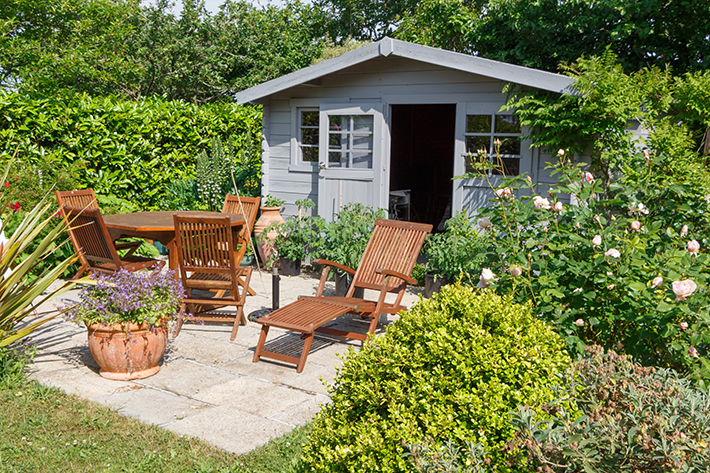
Running power to your shed or other outbuildings makes removing and storing items in your shed more convenient. You can find your way around at night or in the early or late parts of the day. You won’t need to fiddle with a flashlight to find what you’re looking for, and, with proper placement, the interior lights illuminate those nooks and crannies where objects can get lost.
Powering your shed increases safety if it’s done right by a professional, a licensed electrician.
Interior lights prevent accidents inside, and exterior lighting reduces the chances of slips and falls when it’s dark. Also, motion-activated lighting deters thieves, vandals, and troublesome animals, such as raccoons.
A few downsides to running power to your shed include the need for permits, the time involved with running lines to the building and installing fixtures, and the frustration of troubleshooting a technical process fraught with possible errors.
Hiring an electrician solves these problems because he obtains any needed permits and can complete the job quickly, allowing you to benefit from a lighted outbuilding without the hassles of DIYing the installation.
If you are wondering how to run power to a shed or other outbuilding, here are the steps:
Determine the Shed’s Power Needs
Before starting the installation, you’ll need to know the electrical load requirements. For example, whether the outbuilding needs 240v or 120v determines the sizes of the feed wire and the new circuit breaker.
Once you know the power needs, it’s time to determine if your home’s power generation capacity is enough to light the shed. If not, you’ll need to increase the load.
Tip: Save time by adding a subpanel next to the home’s main breaker. This simplifies wiring connections.
Dig the Trench
Firstly, before digging, call 811. You never know where underground utilities may be buried. The 811 operators schedule technicians to locate and mark where underground lines sit.
Secondly, dig the trench deep enough for the lines. For instance, in most areas, code requirements demand the conduit lay at least 18 inches underground. Remember that you need to place several inches of sand in the trench to protect the conduit from rocks, so dig the trench several inches deeper than the required conduit depth.
Tip: A trench digging machine makes this task much faster.
Lay the Conduit
Pros recommend a 1 ½ inch PVC conduit to allow space for pulling wires. You need to use special glue to secure joints. Then, pour sand over the conduit.
Tip: Use a special propane torch to soften the pipe to create small bends in the PVC where needed. Once the plastic cools, the new shape becomes permanent.
Fill the Trench
Once you lay the conduit, backfill the trench with the displaced dirt. You may need to plant grass seeds or distribute mulch to allow the trench to blend into your yard.
Install the Wiring
Run electrician’s fish tape through the conduit. The first step in getting the wires into the pipe is to run an electrician’s fish tape from one end to the other. Then feed through the proper conductors.
Tip: Code requires individual conductors rather than the sheathed conductors used in homes.
Pull the Conduit through the Junction Box
Inside the shed, place the junction box where the conduit comes through the wall. Then, join the individual wires from the conduit with a non-metallic sheathed cable of the same gauge.
Tip: Special connectors and screw caps are used with heavy gauge wire.
Wire the Sub Panel
Within the sub-panel, separate the ground and neutral terminals, unlike in the home’s main panel, where they tie together. Drive a ground rod into the earth outside the shed, then connect the ground terminals to it. Install breakers and surge suppressors in the subpanel.
Tip: Wire the shed using standard interior wiring methods.
Wire the Home Junction Box
The wires from the conduit join the wires from non-metallic sheathed cable in a junction box at the house, as you did at the shed. Then, run the cable through the new panel.
Tip: Place the new panel just below the existing panel.
Electrical Services for Ultimate Safety
By wiring your shed for electric light, you create a safe, versatile environment that you can navigate any time, day or night. If you electrify a detached garage, you are one step closer to adding an electric charger if you plan to park an EV there in the future. An electrified shed or other outbuilding has tremendous advantages. To make the process simple, code-compliant, and safe, contact an electrician to wire your outbuilding today.
It’s a detailed process with the demand for both safety measures and code adherence. Tasks best left to the professionals like Bratcher Electric in Wayne Michigan. Our electrical contracting firm offers both commercial and residential electrical services. We a have more than 60 years of success and customer satisfaction. Safety is our top priority, keeping our employees educated, trained and up to date with the latest guidelines and codes so that our customers are always taken care of.
Whether you need to run electricity to your shed, your home needs new wiring and lighting, or you want to install a reliable back up power system, we’ve got you covered. Our electrical services also include service and code upgrades, surge protection, whole house fans and so much more. Questions? Call and speak with an electrician today, Free!