
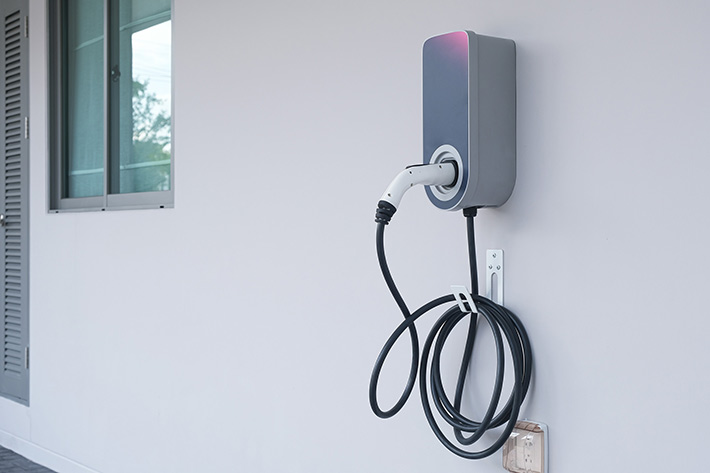
Installing a Level 2 charger in your home may feel like a simple process. How hard can it be to install a box in your garage, right? You just have to run a line, plug it in, and you’re finished. Surprisingly, it really is that easy to install a charger.
However, if you don’t know if your electrical system can support that charger, you may be in for a very expensive lesson.
If you’re lucky, it’ll only cost you the price of hiring a professional to tell you your system needs an upgrade. If you’re not you may experience electrical fires, need car repairs or a new car, and more.
Start with the load, not the charger
Level 2 charging is a steady, long-duration electrical load. In code terms, EV charging is treated as a continuous load, and the circuit and overcurrent protection must be sized accordingly (commonly 125% of the EVSE’s maximum load).
What that means in plain English: a 32-amp charger does not go on a 32-amp breaker. It typically goes on a 40-amp circuit. A 40-amp charger typically needs a 50-amp circuit. A 48-amp charger usually needs a 60-amp circuit. The exact details depend on the equipment and the installation method, but the “size it bigger than the charging amps” rule is a big reason panel capacity comes up so often.
What your panel needs first
Most homes, even older homes, can support Level 2 charging, just not at the fastest charging settings.
Here’s what typically gets checked first:
1) Service size and available capacity
A 100-amp service can typically handle a modest Level 2 charger. However, the charger becomes the straw that breaks the camel’s back.
2) Physical breaker space
Some panels are technically “big enough” on paper but have no open breaker slots. You may need to replace or reconfigure the panel, even if the service size is fine.
3) Panel condition and safety
Loose connections, corrosion, aging bus bars, or past DIY work can turn a straightforward charger install into a safety issue. EV charging is not a good time to discover that a panel has heat damage or questionable terminations.
4) Load calculation documentation when required
Certain communities in Southeast Michigan may require documentation as part of the permitting process. For example, Lyon Township’s EV charging requirements mention permit submittal by a licensed electrical contractor and specifically call out a utility load calculation letter.
Common upgrade triggers in Southeast Michigan homes
You do not always need a service upgrade to add Level 2 charging, but some patterns show up again and again:
● You have a 100-amp service and multiple big electric loads (range, dryer, AC, and now EV charging).
● Your panel is full, and adding a new 2-pole breaker is not realistic.
● Your home has undergone additions or renovations that increased the load, but the electrical service never got updated.
● You want a higher-amp charger for faster charging, which often pushes the circuit requirement to 60 amps and makes capacity tighter.
● The garage is detached or far from the panel, so the run is longer, and the install is more complex.
A practical approach is to decide what you truly need. Many drivers do not need the maximum charging speed. A properly sized 32-amp setup can be plenty for overnight charging, and it is often easier to fit into an existing electrical system.
What your panel usually doesn’t need
This is where people overspend.
You usually do not need an automatic 200-amp upgrade.
Many homeowners hear “EV charger” and assume it means an automatic 200-amp service upgrade. Sometimes that’s the right call, but it should come from a load calculation, not a guess.
You usually do not need the fanciest charger your neighbor bought.
If the electrical system supports it, great. If not, choosing a slightly lower charging rate can keep the project simpler and still meet your daily needs.
Safe placement in real garages, not perfect garages
Placement is not just “where it fits.” It’s about reducing wear, preventing trips, and keeping the install compliant.
A few practical guidelines that matter in Southeast Michigan:
● Put it where the cable naturally reaches the charge port without stretching across a walkway.
● Avoid mounting where it will get bumped by doors, bikes, lawn equipment, or the vehicle itself.
● Think about winter behavior. Cables get stiffer in cold temps. A little extra slack and a good holster or hanger keep the cord from being dragged across the floor.
● Choose the right setup: plug-in or hardwired. Plug-in units can be convenient, but the receptacle and plug become additional connection points that need to be installed correctly and treated with respect. Hardwired installs remove that plug connection and are common for higher-amp charging.
A quick pre-install checklist
Before anyone starts drilling into drywall, it helps to answer a few questions:
● What charging speed do you actually need overnight?
● What is your service size (100A, 150A, 200A)?
● Does your panel have physical space for a new 2-pole breaker?
● Are there signs of electrical issues now (warm breakers, flickering, frequent trips)?
● Where will the charger go so the cable does not cross walking paths?
● Is the garage attached or detached, and how far is the run from the panel?
● What does your city or township require for permits and inspections?
Wayne Electrical Services for EV Charger Installation
If you want a local Wayne electrician to evaluate your panel capacity, recommend an EV charger circuit that fits your needs, and handle permitting across Southeast Michigan, contact Bratcher Electric to schedule an EV charger installation consultation.